
The humanist wedding is increasingly appealing to couples in France, but it faces a significant obstacle: French law grants it no legal value. Only civil marriage, celebrated at the town hall by a civil registrar, produces legal effects. The humanist ceremony remains a symbolic act, no matter how personalized it may be.
For couples attached to this form of celebration, the question arises in very concrete terms: how to reconcile humanist ceremony and legal recognition?
Humanist marriage and civil marriage in France: what the law says
The French Civil Code is clear: only civil marriage creates rights and obligations between spouses. No religious, secular, or humanist ceremony can substitute for it. Civil marriage must be celebrated at the town hall of the municipality where at least one of the future spouses or one of their parents resides.
Humanist celebrants, unlike what exists in several European countries, have no official accreditation in France. Their role is limited to conducting a private ceremony, without legal significance. This is a fundamental difference from countries like Scotland, Ireland, or Norway, where a humanist officiant can legally marry a couple.
| Criterion | Civil Marriage (France) | Humanist Ceremony (France) | Humanist Marriage (Scotland, Ireland, Norway) |
|---|---|---|---|
| Legal Value | Yes, only legal act | None | Yes, recognized by law |
| Officiant | Civil registrar (mayor or deputy) | Unaccredited private celebrant | Accredited humanist celebrant |
| Location | Town hall required | Free (outdoors, castle, home) | Free in most cases |
| Personalization of vows | Very limited (reading of articles from the Civil Code) | Total | Total |
| Effects on assets | Applicable matrimonial regime | None | Applicable local matrimonial regime |
This table highlights the gap between the French situation and that of countries where the recognition of humanist ceremonies has been progressing for several years. When wishing to organize a humanist wedding with Espace Mariage, this legal reality conditions all planning.
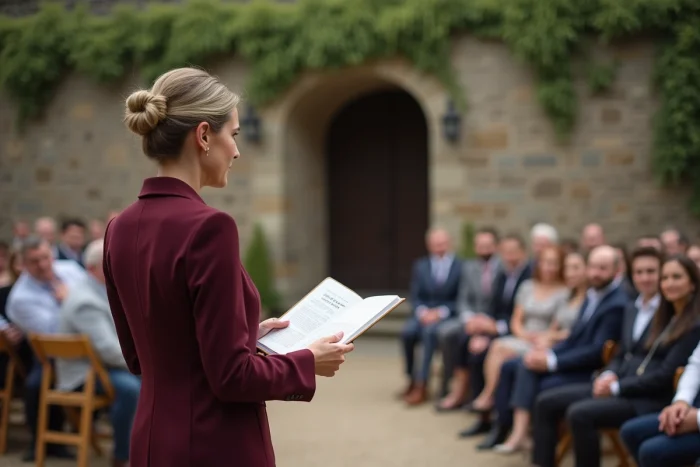
Double Ceremony Strategy: The Necessary Step in France
The solution adopted by almost all couples wishing for a humanist wedding in France is based on a double ceremony: civil marriage at the town hall followed by a humanist celebration at a location of their choice. This is not a shaky compromise. It is the only structure that guarantees both legal protection and symbolic freedom.
Concrete Organization of the Double Ceremony
Two formats dominate. The first consists of celebrating the civil marriage a few days or weeks before the humanist ceremony, often in a small committee. The second combines both on the same day: a visit to the town hall in the morning, and a humanist ceremony in the afternoon at a different location.
- The civil marriage at the town hall requires a file submitted several weeks in advance, including identity documents, proof of residence, birth certificates less than three months old, and information about the chosen witnesses.
- The humanist ceremony requires no administrative formalities: the couple freely chooses the celebrant, the location, the proceedings, and the texts to be read.
- The marriage contract, if desired, must be signed with a notary before the date of the civil marriage, not before the humanist ceremony which has no asset effects.
Practically speaking, the civil marriage must always precede or coincide with the humanist ceremony. Celebrating the humanist ceremony alone, postponing the visit to the town hall to a later date, exposes the couple to a lack of legal protection during the entire interim period.
Marrying Abroad in Front of a Humanist Officiant: A Legal Alternative
A lesser-known option exists for French couples willing to expatriate for a day. Several European countries recognize marriages celebrated by accredited humanist officiants. Scotland has allowed this practice for decades, as have Ireland and Norway.
A humanist marriage celebrated in one of these countries, as long as it complies with local law, can then be transcribed into the French civil registry. The transcription is done at the French consulate in the relevant country or, upon return, at the Central Civil Registry Service in Nantes.
Conditions for Transcribing a Foreign Marriage in France
The transcription is not automatic. The French administration verifies that the marriage meets the substantive conditions of French law: majority of the spouses, free consent, absence of prohibited kinship. A locally valid Scottish humanist marriage will be recognized in France if these conditions are met.
This option involves additional logistics: travel for the couple and witnesses, contacting an accredited humanist celebrant in the chosen country, and a transcription delay that can extend over several months.

Humanist Celebrant in France: A Profession Without Legal Framework
The market for secular and humanist ceremony celebrants has rapidly developed in France in recent years. Private organizations offer training, but there is no public accreditation for French humanist celebrants. The title of celebrant is neither protected nor regulated.
This lack of legal framework has a direct consequence: the couple has no institutional recourse in case of a dispute with a celebrant. The choice relies entirely on word of mouth, online reviews, and preliminary interviews. Checking a celebrant’s references, requesting a detailed outline in advance, and clarifying cancellation conditions in writing remains the only available protection.
The difference with countries like Scotland or Ireland, where humanist celebrants are accredited by organizations recognized by the state, illustrates the lag of French law on this subject. No legislative reform is currently on the agenda to change this situation.
The humanist marriage in France remains, therefore, a matter of strategy: civil marriage at the town hall for the law, humanist ceremony for meaning. Couples who wish to merge the two into a single legal act must, for now, cross a border.