A pool with the filtration system turned off for seven days does not automatically turn into a green pond. The shift depends on the chemical state of the water at the time of shutdown, the outside temperature, and the measures taken before leaving. Managing this situation requires understanding what deteriorates first and at what speed, then acting on each factor before it’s too late.
Water Temperature and Degradation Speed Without Pump
Filtration does the majority of the work to maintain water quality. Without circulation, suspended particles settle, dead zones appear, and the disinfectant is consumed more quickly. The speed at which this process accelerates primarily depends on one parameter: the temperature of the pool.
Cool water (below 22-23 °C) slows the proliferation of microorganisms. In the height of summer, when the pool exceeds 28 °C, chlorine consumption accelerates significantly. Algae then find favorable conditions in just a few days.
This distinction is rarely highlighted, yet it completely changes the strategy. Turning off the filtration for a week in May, with cool nights, does not pose the same problem as in August under 35 °C. It is possible to manage a pool without filtration for 1 week as long as each action is adapted to the season and the pool’s exposure to sunlight.
Balancing and Treating Water Before Departure: Technical Steps
The week without filtration should be prepared two to three days in advance. The principle is simple: the water must start from an impeccable state to last as long as possible without intervention.
Adjusting pH and Performing a Shock Treatment
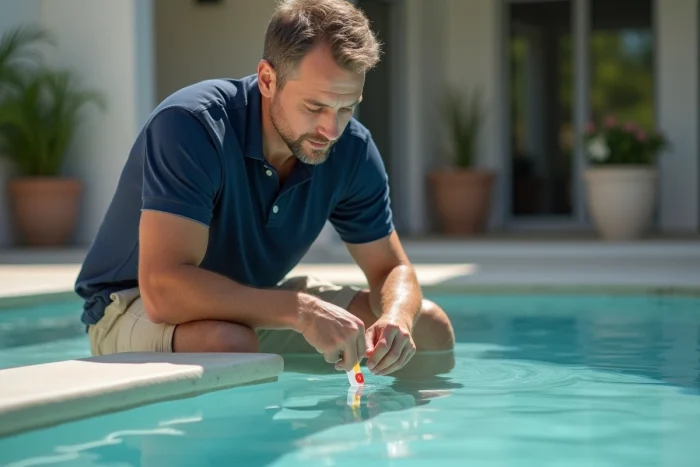
The pH affects the effectiveness of chlorine. A pH that is too high (above 7.4) significantly reduces its disinfecting power. First and foremost, measuring and correcting the pH remains the priority.
Once the pH is stabilized, a shock treatment with chlorine allows for a high concentration of disinfectant to start. This reserve of chlorine will gradually be consumed over the days, and it is what prevents the water from turning in the absence of filtration.
Reducing the Organic Load of the Pool
Every organic debris (leaf, insect, sunscreen residue) consumes disinfectant. Before leaving, a thorough cleaning is essential:
- Vacuum the bottom or use a robot to remove accumulated deposits on the liner and walls
- Completely empty the skimmer basket and the pump pre-filter to avoid any fermentation of trapped organic matter
- Brush the waterline and corners where algae settle first
The less organic matter remains, the longer the chlorine lasts. This direct link between physical cleanliness and chemical stability is the foundation of any successful absence.
Pool Cover and Limiting External Inputs
Without filtration, the pool no longer circulates the water and does not capture surface debris. The cover then becomes the main barrier against degradation.
An opaque tarp or a slatted cover serves two simultaneous functions. It blocks UV rays, which degrade free chlorine, and it prevents leaves, dust, and insects from falling into the water. The benefit is twofold: the disinfectant lasts longer and the organic load does not increase.
A transparent bubble cover protects against debris but allows light to pass through, which promotes algae photosynthesis. For a week without supervision, an opaque cover is clearly preferable.
Intermediate Monitoring: The Often Overlooked Factor
Most guides focus on the chemical and physical actions to take before departure. However, one aspect remains underestimated: beyond a few days, the real risk is the lack of control, not just the absence of treatment.
A chemical imbalance detected on the third day can be easily corrected. The same imbalance discovered upon return, seven days later, has had time to cause an algae bloom that is difficult to manage without partial draining.
Delegating Quick Mid-Point Control
The most reliable solution is to ask a neighbor, a friend, or a service provider to check in once during the week. The check takes just a few minutes:
- Visually check the color of the water (any greenish tint signals the beginning of algae proliferation)
- Test the free chlorine level with a strip and add a supplement if the level has dropped too low
- Remove large visible debris from the surface with a net
- Check that the cover is still properly positioned
This single visit significantly reduces the risk. Without it, the strategy relies entirely on the initial preparation, which works under ideal conditions but leaves little margin if a storm or heatwave occurs during the week.
Recovery Upon Return: Act Quickly Based on Water Condition
Upon return, two scenarios arise. If the water has remained clear and the chlorine level is detectable, simply restart the filtration, check the pH, and resume the normal treatment cycle.
If the water has turned green or appears cloudy, restarting requires a more substantial intervention. A new shock treatment is necessary, combined with a thorough brushing of the walls and bottom. The filtration must then run continuously for at least twenty-four hours to eliminate dead algae and suspended particles. A filter cleaning (backwashing for a sand filter, rinsing for a cartridge) is required as soon as the pressure rises.
In the most advanced cases, where the water has turned dark green with an invisible bottom, a flocculant can accelerate clarification by agglomerating fine particles that the filter alone struggles to capture.
The quality of the preparation before departure directly determines the extent of the recovery upon return. Well-balanced water, a clean pool, and an opaque cover remain the three pillars of a week without filtration that does not turn into a technical nightmare.