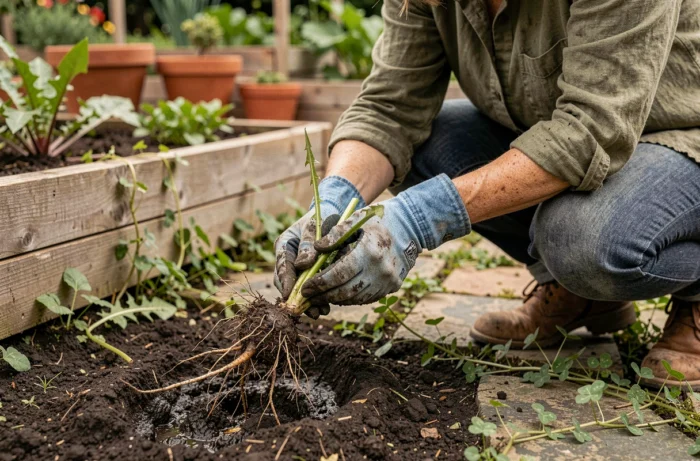
A mass of perennials overrun by bindweed in three weeks, gravel paths where dandelions settle between each joint: we all know that moment when weeds seem to grow faster than everything else. Before seeking the miracle recipe, it’s better to understand what is sprouting in your garden and adapt the method to the type of weed.
White vinegar and salt in the garden: a misleading regulatory good idea
They can be found in most online guides, presented as natural herbicides without risk. White vinegar, salt, the water-vinegar-dish soap mixture: these homemade recipes circulate everywhere. The problem is not their effectiveness on a small clump of clover, but their legal status.
In France, using an unapproved substance as a herbicide is prohibited, even if it comes from the kitchen cupboard. Household vinegar is not registered as a plant protection product. In practical terms, spraying white vinegar on a path to destroy weeds constitutes a misuse according to the regulations.
Salt poses an additional problem: it does not degrade. Regularly spread, it accumulates in the soil, degrades the structure, and prevents any subsequent cultivation in the treated area. You can also find advice on Conseil Jardin detailing the compliant alternatives to prioritize.
Since July 1, 2022, the Labbé law prohibits individuals from using conventional plant protection products in gardens and outdoor spaces of private properties. Only certain low-risk biocontrol products or those usable in organic farming remain authorized, provided they have a valid authorization.
Weeding according to the type of weed: rhizomes, taproots, and annuals
All competitors offer a list of methods (manual, thermal, mulching). None start with the question that conditions everything else: what weed do you have in front of you?
Rhizome weeds: couch grass, horsetail, knotweed
These plants spread underground through a network of underground stems. Pulling out the visible part is not enough: the slightest fragment of rhizome left in the soil gives rise to a new plant. Traditional digging often exacerbates the problem by cutting the rhizomes, which multiplies the regrowth points.
The most reliable method for this type of weed is to cover the area with an opaque tarp for several months. This deprives the root system of light, gradually exhausting the plant’s reserves. Feedback varies on the duration needed depending on the species and soil, but it rarely involves less than a full season.
Taproot weeds: dandelion, dock
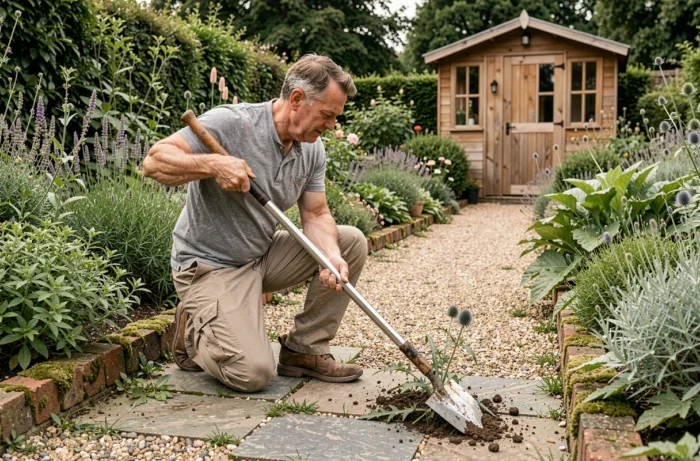
Dandelions can be effectively pulled out with a weeding knife or gouge, provided the root is extracted in its entirety. The intervention is more effective before flowering and seed dispersal. After rain, the loose soil facilitates complete extraction.
Annuals: chickweed, starwort, groundsel
These are the easiest to manage. A superficial hoeing in dry weather eliminates them in a few passes. The key is consistency: we intervene every two to three weeks between March and October to prevent seed setting.
Mulching and ground covers: preventing germination rather than weeding
The most effective weeding is the one you don’t have to do. A bare soil is a permanent invitation for weeds, which colonize every inch exposed to light.
- Organic mulching (branch chippings, straw, dead leaves) covers the soil with a sufficient thickness to block light. It decomposes over time and nourishes the soil but must be renewed once or twice a year.
- Mineral mulching (slate, pumice, gravel) is suitable for paths and Mediterranean beds. It does not decompose but does not nourish the soil either. Beware: fine weed seeds eventually germinate in the dust that accumulates between the stones.
- Ground cover plants (creeping thyme, creeping bugle, dwarf clover) occupy the ground space and limit the germination of weeds through direct competition for light and nutrients.
A properly laid mulch drastically reduces weeding, provided the area is weeded before installation. Mulching over perennial weeds amounts to protecting them.

Thermal weeding on terraces and paths: what really works
The thermal weeder (gas or electric) is often presented as the universal solution. In practice, it is mainly suitable for hard surfaces: terrace joints, paved paths, curb edges.
The principle is not to burn the plant to carbonization. A quick pass is enough to make the plant cells burst through thermal shock. The plant wilts in the hours that follow. For annuals, a single pass may suffice. For rhizome perennials, the operation needs to be repeated several times at intervals of a few weeks to exhaust the underground reserves.
In open ground, thermal weeding remains of little relevance. The heat does not penetrate enough to reach the deep roots, and there is a risk of temporarily sterilizing the soil’s microfauna at the surface.
- On slabs and pavers: effective from the first pass for young shoots, to be repeated three to four times per season.
- On gravel: acceptable results if the layer of gravel is thin, less convincing on generous thicknesses where seeds germinate deeply.
- On beds and vegetable gardens: to be avoided, heat disrupts soil life and does not reach developed root systems.
The choice between gas and electric mainly depends on the area to be treated. Gas models offer more autonomy over long stretches of path, while electric ones are suitable for small terraces.
Managing weeds over time involves a combination of regular actions rather than a single method. Identifying what is growing, covering the soil where possible, intervening early and often in exposed areas: it is this routine, adapted to each type of surface and weed, that yields the most lasting results.