A child pulling at the sleeve to add a drawing to the thank-you card after a funeral, or wanting to sign their name next to that of the adults: this situation is common and can be unsettling. One hesitates between a sense of pride and the fear of making a mistake. Involving a child in writing a thank-you note after a bereavement, a wedding, or a celebration requires a simple framework, not a complex educational method.
Co-writing child-adult: structuring the message without stifling enthusiasm
The challenge is not that the child wants to participate. It’s that we don’t know what to entrust them with. Giving them free rein often results in something that feels out of sync with the expected tone. Locking everything down means asking them to copy a sentence they don’t understand.
The most effective method is to separate the structure from the personal content. The adult sets the skeleton of the message: a greeting, a reminder of the gesture received, a closing phrase. The child provides the concrete material, a specific memory, a word they associate with the person being thanked, a visual detail.
When it comes to writing a thank-you card after a death, this division of roles makes perfect sense: the adult carries the gravity of the message, while the child adds a sincere fragment that personalizes the note without distorting it.
In practice, the work can be divided into three quick steps:
- The adult writes the first and last sentences, those that provide the formal framework and the right tone for the recipient.
- The child chooses a memory or a word that they dictate or write themselves, depending on their age, for the central part of the message.
- We read it together aloud to ensure that it sounds natural, and we adjust a word if necessary.
This division avoids two pitfalls: a 100% adult text that the child signs without having contributed anything of themselves, and a childish message that makes the recipient uncomfortable in a solemn context.
Drawing, collage, or signature: adapting the channel to the child’s level
We instinctively think of writing, but a four-year-old does not write sentences. The channel of participation must correspond to what the child can do, not to what we would like them to be able to do.
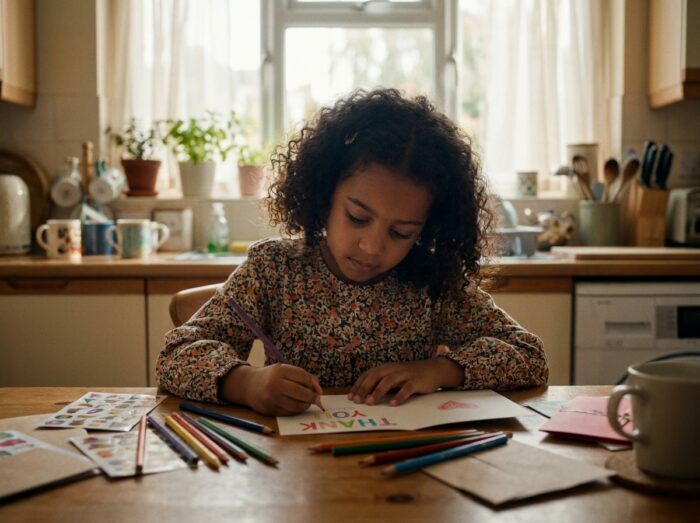
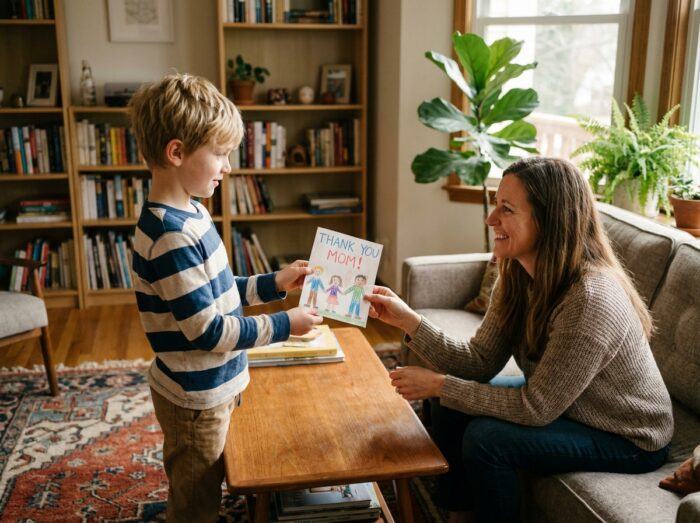
Before the age of six, drawing remains the most reliable medium. A sun, a flower, a smiling stick figure: it is readable by the recipient and authentic. We can stick the drawing inside the card or slip it in as a separate insert.
Between six and nine years old, a signature and a short dictated or copied sentence work well. The child writes “thank you for the flowers” or “I’m thinking of you” in their school handwriting, and this graphical clumsiness conveys more sincerity than a printed font.
From the age of ten, we can propose a more written participation. The child formulates two or three sentences themselves, which the adult reads to check the tone without rewriting the content. The rule remains the same: the adult corrects the form, never the feelings expressed by the child.
The trap of the “pretty” thank-you
Sometimes we want the note to be “beautiful.” We rephrase, smooth it out, replace the child’s vocabulary with more adult expressions. The result loses exactly what we were trying to achieve: the child’s voice. If the child’s sentence is grammatically correct and respectful, it should remain as is.
Thank-you after a bereavement: what we say and what we keep silent in front of the child
The context of bereavement complicates the child’s participation, not because they do not understand death, but because the adults around them do not always know what to explain about the social ritual that follows.
A child participating in a thank-you note after a death needs simple information: we thank the people who were present, who sent flowers, who helped the family. Naming the object of gratitude makes the process concrete for the child, rather than remaining in an emotional blur that they cannot manage.
What we avoid: asking the child to express a calibrated sorrow. “Say that you are sad” produces nothing good. Instead, we suggest they share a pleasant memory of the deceased person, or simply sign the family card. Responses vary on this point; some children want to say a lot, while others prefer just to write their name.
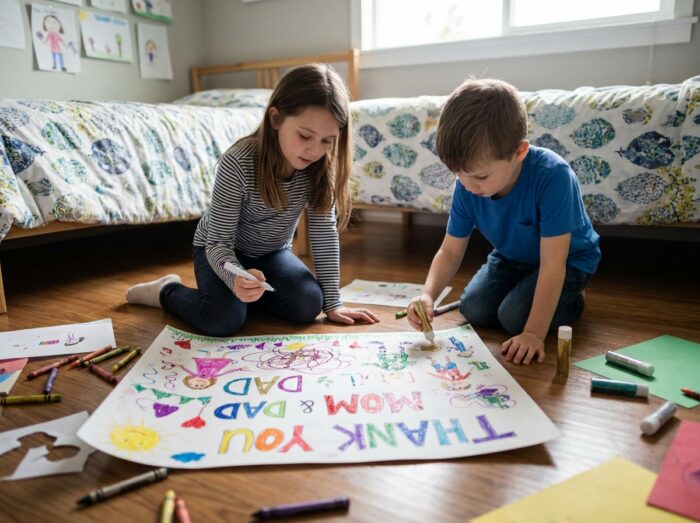
Thank-you after a gift or a party: establishing concrete markers
Outside the context of bereavement, the child’s participation in the thank-you is lighter but still requires a framework. The issue is not mechanical politeness (the automatic “say thank you”), it’s learning to name what has been received and what it has caused.
Four markers help the child construct their message without needing us to whisper every word:
- Note what they received: an object, help, a presence, a shared moment.
- Think about the person who made this gesture: who they are, what effort they made.
- Identify what they felt: joy, surprise, comfort, amusement.
- Choose how to express it: a drawing, a written word, a voice message, a decorated card.
This four-step framework (note, think, feel, express) works for both a thank-you after a birthday and an end-of-year note addressed to a teacher. The child chooses the channel themselves, which reinforces the personal dimension of the gesture.
The right moment to propose participation
Asking a child to thank when they are still playing with their gift does not work. The thank-you should be prepared at a calm moment, the day after or a few days after the event, when the excitement has subsided and the child can focus on what they want to say.
A co-written thank-you note will never replace felt gratitude. However, it provides the child with a framework to transform a vague impulse into a precise gesture, readable by the recipient. The adult’s role is limited to setting the structure and protecting the child’s voice within that structure.